As an Amazon Associate I earn from qualifying purchases.
Living with a dog or a cat changes what an air purifier has to do. Dander is not dust: the skin flakes that trigger most pet allergies are roughly 2.5 to 10 microns, light enough to stay airborne for hours and to settle back into the air every time someone walks across the room. Hair and fur are the opposite problem — heavy, visible, and quick to blanket a pre-filter. And pet odor is not a particle at all. It is a gas, which means a HEPA filter, however good, does nothing to it.
So the best air purifier for homes with pets is really doing three separate jobs: catching fine dander, surviving hair without choking, and absorbing odor with activated carbon. The five units below are compared on the specifications their manufacturers publish, for each of those jobs.
Quick comparison

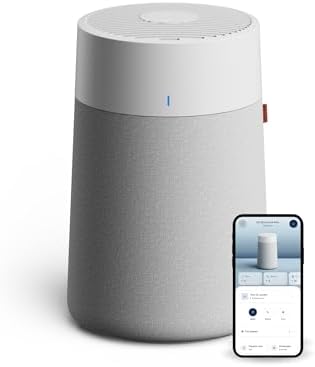

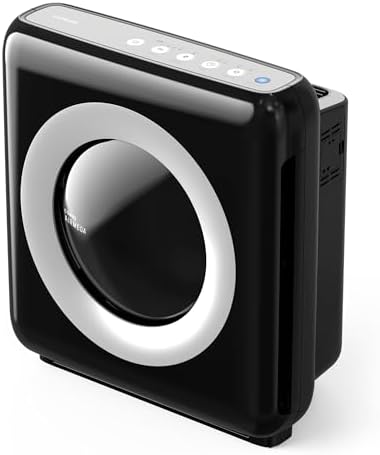
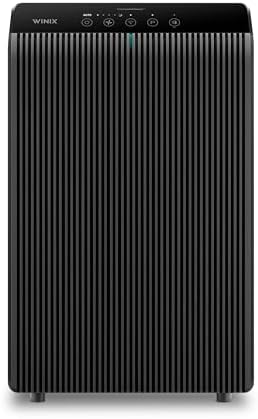
Prices and availability as of September 2, 2026 02:29 UTC. Product prices and availability are accurate as of the date/time indicated and are subject to change. Any price and availability information displayed on Amazon.com at the time of purchase will apply to the purchase of this product.
The number most buyers read wrong
Coverage figures are the single biggest source of confusion in this category, because two very different numbers get printed the same way.
Manufacturers usually headline the room size at one air change per hour — the purifier moves a volume of air equal to the room once every sixty minutes. That is a fine benchmark for general freshness. It is not enough for pet dander, which keeps being regenerated all day by an animal that lives there. For allergens you want the air turned over four or five times an hour.
Levoit publishes both numbers for the Core 300-P, which makes the gap easy to see: 1,073 sq ft at one air change per hour, but 222 sq ft at 4.8 changes per hour. Same machine, same day, a difference of nearly five times. Winix does the same thing from the other direction — AHAM Verifide at 392 sq ft, while the headline says up to 1,882 sq ft in one hour.
Practical rule: take the advertised coverage and divide by four. That is roughly the room the unit will actually keep clear of dander.
Which one fits your situation
A bedroom the pet sleeps in
Noise decides this one, because the unit has to run all night on a speed that actually moves air. The Blueair Blue Pure 511i Max is rated at 19 dB at its quietest, the lowest published figure of the five, and it clears 237 sq ft in about 12.5 minutes. The Levoit Core 300-P is close behind at 24 dB in Sleep Mode, with a dimmable display.
Both are small-room machines. Neither will handle an open-plan floor, and neither should be asked to.
Litter box, dog beds, and smells that will not leave
This is where HEPA-only units disappoint people, and where the honest answer is carbon. The Coway Mighty AP-1512HH runs a four-stage system — washable pre-filter, a dedicated deodorization filter, a Bipolar Device, and HEPA — and Coway states it reduces volatile organic compounds and odor, not only particles. The Winix 5510 takes the same approach with a high-deodorization carbon filter aimed specifically at cooking, pet, and smoke odors.
If odor is your main complaint, a purifier without a real carbon stage is the wrong purchase, no matter how good its HEPA rating looks.
A large or open-plan living area
Two units are built for volume. Coway states 1,748 sq ft in 60 minutes; Winix states 1,882 sq ft in one hour, with intermediate figures published for smaller rooms — 941 sq ft in 30 minutes, 627 in 20, 470 in 15. Those intermediate numbers are more useful than the headline, and it is worth noting that Winix is the only one of the five that publishes them.
They are also the two heaviest units here, at 12.3 and 13.3 pounds. These stay where you put them.
Heavy shedding
Hair is a mechanical problem before it is a filtration problem: it mats across the intake and strangles airflow, and performance falls off long before the filter indicator notices. The Shark Clean Sense HP102PET ships with a dedicated Pet Filter and is the only unit of the five sold specifically in a pet configuration. Shark rates it at 99.98% capture down to 0.2 microns, against 500 sq ft at one air change per hour.
Whatever you buy, a washable pre-filter — which Coway and Winix both have — is worth more in a shedding household than a slightly better HEPA rating.
Smallest sensible budget
The Levoit Core 300-P is the entry point, and it is AHAM Verifide, which matters more than the price: the seal means an independent body measured its Clean Air Delivery Rate rather than the manufacturer publishing its own. Its CADR is 143 CFM for smoke, 153 for dust, 167 for pollen, and it filters 99.97% of particles between 0.1 and 0.3 microns.
One constraint that is easy to miss: it runs on 120V and Levoit states it is suitable for use only in the United States.
Before you buy
Check what the replacement filters cost, not just the unit. A purifier in a pet household is a subscription. Shark states replacement every 6 to 12 months of continuous use; carbon stages generally saturate faster than HEPA, and in a home with animals they will.
Measure the room and divide the coverage by four. See above. This single step prevents most disappointed reviews in this category.
Decide whether you need sensors. Blueair, Coway, Winix, and Shark all include air quality sensing with automatic fan adjustment; the Levoit Core 300-P does not. In a pet home the air quality changes constantly, so auto mode earns its keep — but it also means the unit spends more time at higher, louder speeds.
Look at where the air comes in. A 360-degree intake, like the Blueair’s, can sit closer to a wall than a front-intake unit. In a small bedroom that decides whether it fits at all.
Common questions
Will an air purifier stop my pet allergy?
It reduces airborne dander; it does not remove what has already settled into carpet, upholstery, and bedding. A purifier is one part of the job, alongside cleaning the surfaces the dander lands on.
Does a HEPA filter remove pet smell?
No. HEPA captures particles. Odor is gaseous and needs activated carbon, which is why the units with a dedicated deodorization or carbon stage are the ones listed for odor above.
Where should it go?
In the room where the animal actually spends its time, not the room you spend yours. Dander concentration is highest where the pet sleeps.
Should it run all the time?
Yes, if you can stand the noise. Dander is produced continuously, so intermittent running lets it build back up between sessions. This is why the published quiet-mode figure matters more than the maximum fan speed.
How this comparison was made
Every figure above — coverage, air changes, CADR, decibels, filtration percentages, weights — is taken from the manufacturer’s own published specification for that model. We have not run our own laboratory tests, and we do not present these as independent measurements. Where a manufacturer does not publish a figure, we have not estimated one: Shark and Coway do not publish a decibel rating, and that is why no noise number appears for them.
More air purifier guides for pet owners: Pets.